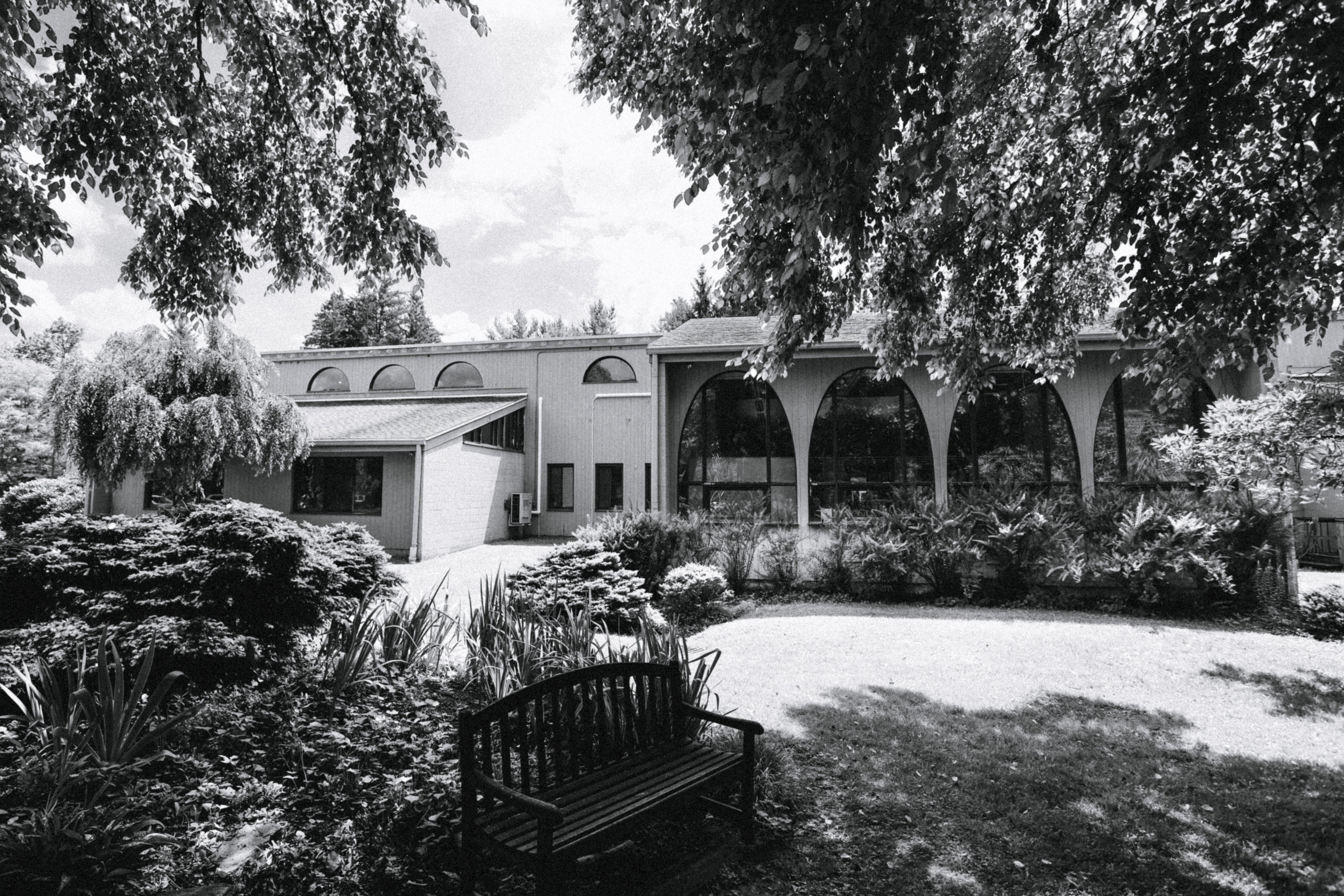
Situated between The Clark Art Institute and Williams College, Milne Public Library is just one star in the constellation that makes up Williamstown’s rich arts culture.
My experience of Milne started well before entering the library.
A massive construction site caught my attention just before the library’s entrance. Across from Milne and the town rotary was an unfinished building frame topped with an undulating roof that was peppered with men in hard hats. After some research, I learned that it will be the new home of the Williams College Museum of Art, the roof’s pitch intended to reflect the surrounding mountainous landscape. The space will offer a gallery as well as object study classrooms supporting the college’s goal to “thrive as a leader and innovator among college art museums.”
The moment my eyes were upon Milne Public Library, I knew it was going to be unlike most on my tour.
The north face of the building resembles 1960s California-style architecture with large, arched windows (originally intended to mimic Williamstown’s First Congregational Church and Thompson Memorial Chapel) that are accentuated by gardens. The library’s east face takes on a completely different facade. Various sharp angles jut into the sky rising from Brutalist slabs of concrete and cinder block.


Assistant Director Kirsten Rose told me the building was originally Pine Cobble School. When the school relocated, David and Joyce Milne donated it to the town and, after renovations, it officially became Milne Public Library in 1996. It’s the second largest public library in Berkshire County, after Berkshire Athenaeum in Pittsfield.
The interior is just as deserving of one’s excitement. One main hallway runs the length of the building, a spine full of possibilities… fiction and non-fiction books, DVDs and CDs, a seed library, a large children’s wing, a brick fireplace, a Sensory Sanctuary, teen and young adult rooms, a café-esque sitting area, and two meeting rooms (one of which was at full capacity for “Mahjong at the Milne” during my visit).


As I approached the end of Milne’s spine, I stumbled into a large, dark room that, at first glance, seemed like storage. The dim light managed to illuminate piles of books stacked on tables, unsettled and waiting to be moved to their next location. A row of various-sized bookshelves curved like a snake, creating coves and a walkway that brought some order. A man emerged from an opening between the tables with both hands clasping books, waving them around as he talked. The books were more like extensions of his body rather than separate objects he was holding. He was a volunteer for the Friends of Milne Library. The room is headquarters for Chapter Two Books, their used bookstore in Williamstown, which profits the library.


Tucked behind the library is what can only be described as a quintessential backyard, including a vegetable garden, pollinator garden, ping pong table, gazebo, and two sheds. Conversely, the front of Milne is a reading garden oasis. Trees tower over a couple of benches and a curved garden bed (featuring a real millstone), which is maintained by the Williamstown Garden Club.


The Williamstown public library was established in 1874. Its original collection was only about 100 books, focused mostly on agriculture. It began in two rooms above a hardware store and was open just nine hours a week.

